

















Species ID
OC-SP-0002654
Discovered
Phylum
Platyhelminthes
Species ID
OC-SP-0002654
Provisional Species Name
Typhlopolycystis sp_IRLBB_00550
Lowest Valid Taxon Name in WoRMS
Typhlopolycystis
Lowest Known Rank
Genus
Status
Discovered
Does the taxonomist(s) intend to work on this material further?
2. I/We already have plans to publish. (For marine invertebrates please know that SOSA could support you in this too - please click the button for more details).
Embargo
No
Kingdom
Animalia
Phylum
Platyhelminthes
Order
Rhabdocoela
Family
Polycystididae
Genus
Typhlopolycystis
Taxonomic Remarks
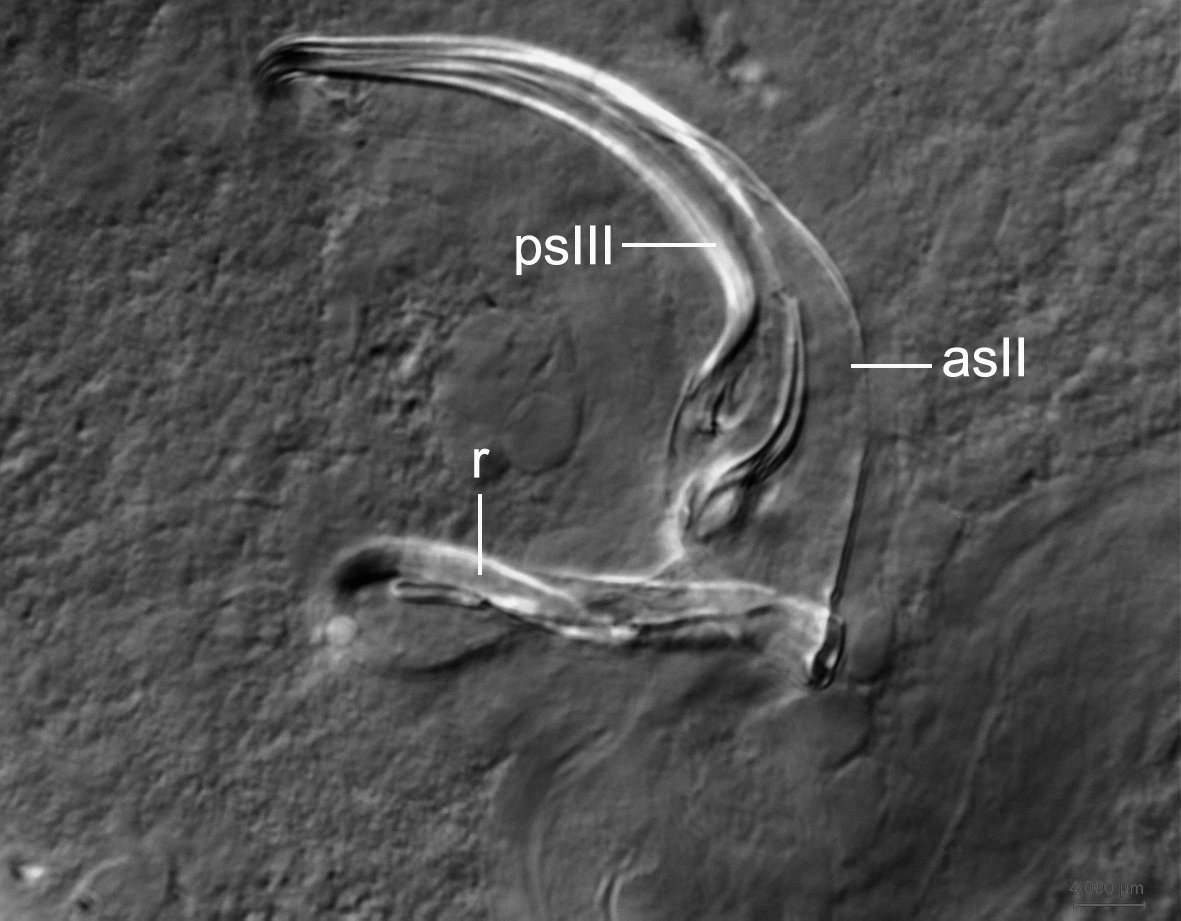
The morphology of the male sclerotised structures in Typhlopolycystis sp.2 indicates a close relationship with the ‘rubra’ group of Typhlopolycystis, which includes T. coomasi, T. rubra, T. riegeri, T. tahitiensis, T. pluvialiae, T. maikoni, T. leasiae, and probably T. australiensis. In this group, both stylets run closely together, more or less parallel to each other. Typhlopolycystis sp.2 is most comparable to T. rubra, T. pluvialiae, and T. maikoni due to similarities in the curved prostate stylet type III (psIII) and accessory stylet type II (asII), and because the psII tapers to a sharp distal tip. However, T. pluvialiae and T. maikoni are excluded from closer comparison, as their psIII does not taper distally but ends in a broad, rounded tip. Typhlopolycystis sp.2 is primarily distinguished from T. rubra by the presence of a well-developed lateral projection on the ring connecting the stylets—a feature absent in T. rubra. Furthermore, the stylets of T. rubra are much longer (psIII 105–120 µm; asII 80–90 µm) than those of Typhlopolycystis sp.2 (psIII 41–56 µm; asII 36–54 µm).
Discovery registered on
01/04/2026
Description of Material
Species of Typhlopolycystis without eyes and a relatively short proboscis. Prostate stylet type III measuring 41–56 µm in length (x¯ = 51 µm; n = 6), curved, and tapering to a rounded distal tip. The accessory stylet type II is 36–54 µm long (x¯ = 42 µm; n = 6), also curved, and tapers to a sharp distal tip. Both stylets are proximally connected by a ring that bears a lateral projection directed toward the concave side of the stylets.
Ecology
Medium-grained and well-sorted sand, 10 m deep, salinity 37 ‰.
Distribution
United States of America, Florida, 6.75 km SE from the mouth of Fort Pierce Inlet, 27.429300; -80.241083.
Scientific Name Authorship
Diez, Yander L.
Specimens
Additional Material
No Image yet…
IRLBB_01674
Phylum
Platyhelminthes
Family
Polycystididae
Additional Material
No Image yet…
IRLBB_01688
Phylum
Platyhelminthes
Family
Polycystididae
Primary Voucher
IRLBB_00550
Phylum
Platyhelminthes
Family
Polycystididae
Additional Material
No Image yet…
IRLBB_00738
Phylum
Platyhelminthes
Family
Polycystididae
Additional Material
No Image yet…
IRLBB_01021
Phylum
Platyhelminthes
Family
Polycystididae
Additional Material
No Image yet…
IRLBB_01029
Phylum
Platyhelminthes
Family
Polycystididae
Additional Material
No Image yet…
IRLBB_01186
Phylum
Platyhelminthes
Family
Polycystididae
Additional Material
No Image yet…
IRLBB_01597
Phylum
Platyhelminthes
Family
Polycystididae
Join the census
The Ocean Census Alliance unites national and philanthropic marine institutes, museums, and universities, backed by governments, philanthropy, business and civil society partners.


