















Species ID
OC-SP-0002646
Discovered
Phylum
Platyhelminthes
Species ID
OC-SP-0002646
Provisional Species Name
Schizorhynchidae sp_IRLBB_01009
Lowest Valid Taxon Name in WoRMS
Schizorhynchidae
Lowest Known Rank
Family
Status
Discovered
Does the taxonomist(s) intend to work on this material further?
2. I/We already have plans to publish. (For marine invertebrates please know that SOSA could support you in this too - please click the button for more details).
Embargo
No
Kingdom
Animalia
Phylum
Platyhelminthes
Order
Rhabdocoela
Family
Schizorhynchidae
Taxonomic Remarks
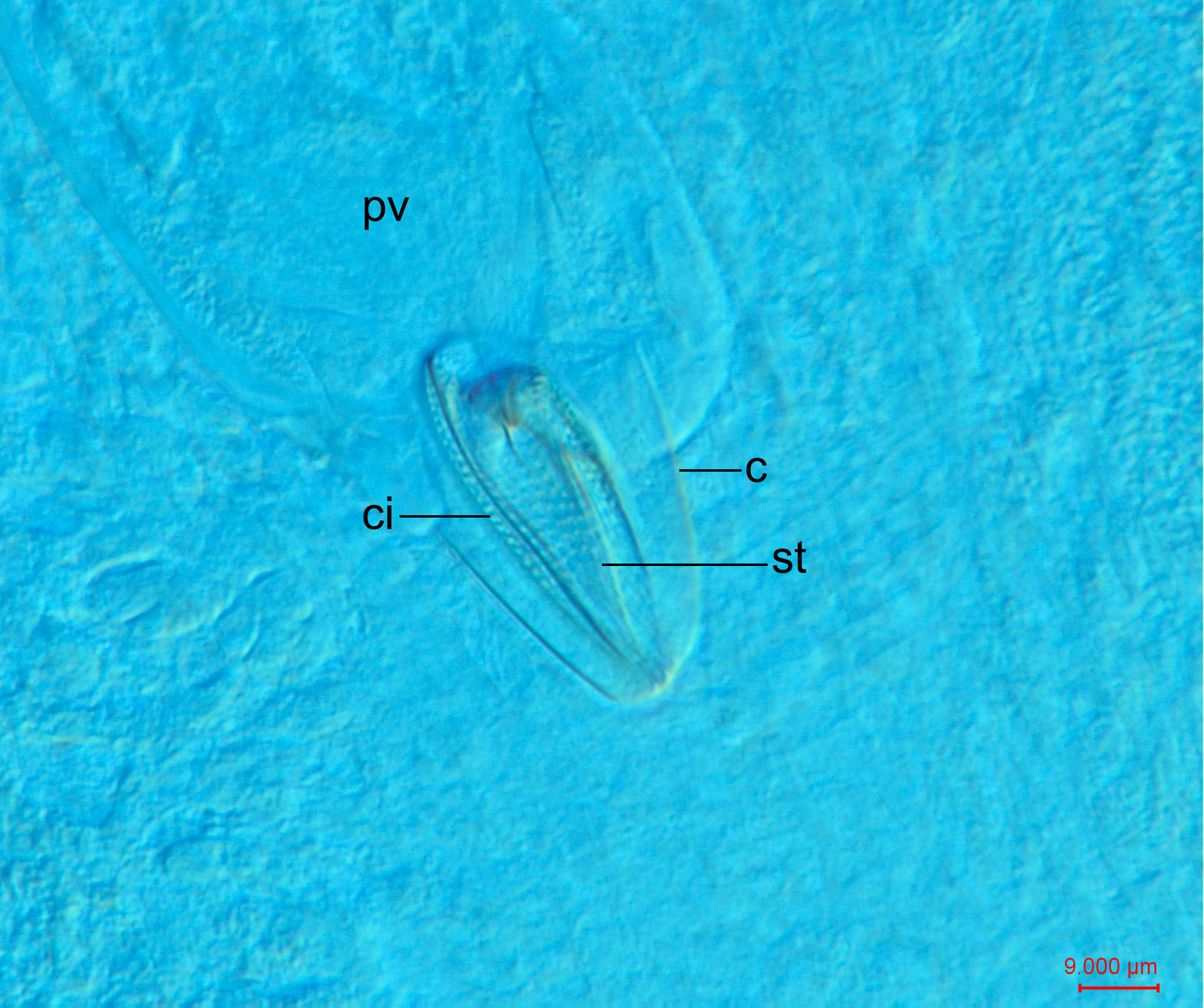
Schizorhynchia comprises all rhabdocoel microturbellarians that possess a proboscis divided into two tongues, which may be armed with hooks or unarmed. Species lacking hooks are assigned to the family Schizorhynchidae, as is the case for the new species described here, Schizorhynchidae sp.1. This species cannot be assigned to any previously described genus within Schizorhynchidae due to a unique combination of characters of the male copulatory bulb. The male copulatory organ consists of a spiny cirrus, a stylet, and a distal sclerotised cap. Taken together, these structures resemble those found in species of Proschizorhynchus; however, representatives of that genus lack a distal cap. A similar combination of a cirrus, stylet, and distal cap occurs in some species of Schizochilus. Nevertheless, species of Schizochilus (with the exception of S. banesensis) possess multiple testes arranged in a row anterior to the pharynx, whereas the two testes of Schizorhynchidae sp.1 are located laterally in the body. Moreover, species of Schizochilus have a pair of well-differentiated glands, sheathed by muscles, opening posterior to the proboscis, while in Schizorhynchidae sp.1 these glands are not surrounded by muscles. Finally, the characteristic bursal mouthpiece present in species of Proschizorhynchus is absent in Schizorhynchidae sp.1. Consequently, no further meaningful comparisons can be made between Schizorhynchidae sp.1 and other members of the family Schizorhynchidae.
Discovery registered on
01/04/2026
Description of Material
Species of Schizorhynchidae with the pharynx located in the anterior body half. Proboscis without a pair of posterior glands sheathed by muscles. A pair of testes anterior to the pharynx; testes located at the body sides. Atrial organs located in the posterior half of the body. The male bulb receives the seminal vesicles and encompasses the prostate vesicle, a cirrus, a stylet, and ends in a sclerotised cap. The stylet is 33–38 µm long (x¯ = 36 µm; n = 2), the cap is 35–41 µm long (x¯ = 38 µm; n = 2), and the spines of the cirrus are 1.5–4 µm long.
Ecology
Medium-grained and well-sorted sand, 10 m deep, salinity 37 ‰.
Distribution
United States of America, Florida, 6.75 km SE from the mouth of Fort Pierce Inlet, 27.429300; -80.241083.
Scientific Name Authorship
Diez, Yander L.
Join the census
The Ocean Census Alliance unites national and philanthropic marine institutes, museums, and universities, backed by governments, philanthropy, business and civil society partners.


