













Species ID
OC-SP-0002650
Discovered
Phylum
Platyhelminthes
Species ID
OC-SP-0002650
Provisional Species Name
Schizorhynchidae sp_IRLBB_01334
Lowest Valid Taxon Name in WoRMS
Schizorhynchidae
Lowest Known Rank
Family
Status
Discovered
Does the taxonomist(s) intend to work on this material further?
2. I/We already have plans to publish. (For marine invertebrates please know that SOSA could support you in this too - please click the button for more details).
Embargo
No
Kingdom
Animalia
Phylum
Platyhelminthes
Order
Rhabdocoela
Family
Schizorhynchidae
Taxonomic Remarks
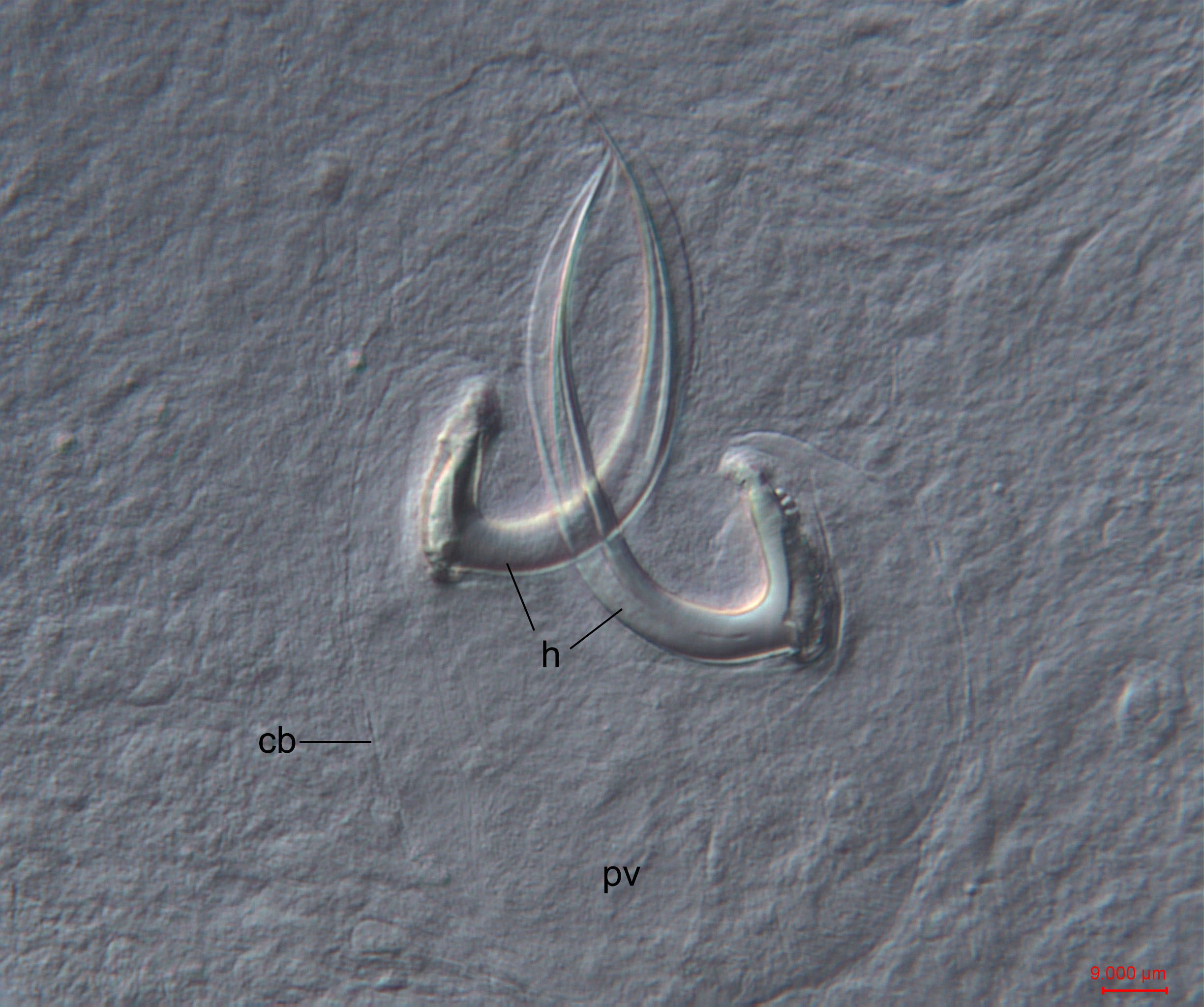
Schizorhynchidae sp.5 is characterised by a male copulatory bulb with an unarmed ejaculatory duct that does not form a cirrus and by the presence of a pair of strong, curved distal hooks. In this species, the brain is well differentiated and appears to be encapsulated. The testes are arranged in six pairs anterior to the pharynx, which is positioned at the end of the anterior half of the body. These characters suggest a close relationship between Schizorhynchidae sp.5 and the genera Schizorhynchoides and Schizorhynchus, both of which include species with male copulatory bulbs armed with hooks. However, species of Schizorhynchoides and Schizorhynchus possess only one to two pairs of testes anterior to the pharynx, and in some species a stylet perforated by the ejaculatory duct is present. Moreover, the curved hooks observed in Schizorhynchidae sp.5 are not comparable to the hooks or stylets known from any described species of Schizorhynchidae. Consequently, Schizorhynchidae sp.5 is recognised as a new species with uncertain generic affinities.
Discovery registered on
01/04/2026
Description of Material
Species of Schizorhynchidae without eyes. Proboscis well-developed, with symmetric lips, and without posterior glands sheathed by muscles. Eyes absent. Brain well-differentiable and seems encapsulated. Pharynx located at the end of the anterior body half. Six pair of testes anterior to the pharynx. Atrial organs located in the posterior third of the body. The male bulb receives the seminal vesicles and encompasses the prostate vesicle, and two strong curved hooks. The hooks are 94–96 µm long (x¯ = 95 µm; n = 2), show a proximal broad ‘handle’ and taper to distal sharp tips. Ejaculatory duct unarmed. Ovary and bursa located posterior to the male system. The bursa opens to the common genital atrium through a strong bursal stalk, which seems partially sclerotized at its proximal part. Insemination duct not observed.
Ecology
Shell hash, well-sorted, 1 m deep, salinity 37 ‰.
Distribution
United States of America, Florida, Jupiter, Dubois Park, 26.942900; -80.073280.
Scientific Name Authorship
Diez, Yander L.
Join the census
The Ocean Census Alliance unites national and philanthropic marine institutes, museums, and universities, backed by governments, philanthropy, business and civil society partners.


