























Species ID
OC-SP-0002874
Discovered
Phylum
Mollusca
Species ID
OC-SP-0002874
Provisional Species Name
Terebra aurantiaca sp_MNHN-IM-2013-47732
Lowest Valid Taxon Name in WoRMS
Terebra
Lowest Known Rank
Genus
Status
Discovered
Does the taxonomist(s) intend to work on this material further?
3. I/We are not sure yet. This is of course no problem, we will display your species info (if not embargoed) while you work out your species description plan.
Embargo
No
Embargo End Date
08/04/2027
Kingdom
Animalia
Phylum
Mollusca
Class
Gastropoda
Order
Neogastropoda
Family
Terebridae
Genus
Terebra
Date Identified
01/11/2025
Taxonomic Remarks
Largest specimen studied 120 mm. The species shows considerable variability in terms of sculpture on the surface of the shell, which is somewhat typical for this group of large Terebra and in particular for the kind of sculptural variability noted in T. grimwoodi Terryn, 2022 i.e. between the early and later sculpture on the same shell and (hence) between different specimens and to a certain extent between various populations or localities. But all have very similar to identical sculpture on the first 5-10 whorls of the teleoconch which evolve differently ranging from maintaining a rather coarse spiral sculpture on the remainder of the whorl to a discrete sculpture of appearing almost smooth with only (sometimes even discontinuous) spiral incisions visible (which originate from the incisions between the raised continuous spiral cords). The coarse nodular features on and below the subsutural band together with the strong spiral sculpture in some specimens can pertain till maturity, where only in the last whorls these features become smoothened. The color is usually in shades of orange, while paler, fawn-coloured specimens are encountered in Papua New Guinea. Specimens of Terebra aurantiaca sp. nov. have in the past often been referred to as Terebra punctatostriata J. E. Gray, 1834 or Terebra straminea J. E. Gray, 1834. A recent revision of the type material of T. punctatostriata and of the type material of the historical synonyms reveals it to be conspecific with T. cingulifera Lamarck, 1822. Hence the revised synonymy of T. cingulifera reads: Terebra punctulata G. B. Sowerby I, 1825; Terebra punctatostriata J. E. Gray, 1834; Terebra pallida Deshayes, 1857; Perirhoe exulta Iredale, 1931. At present, treating T. columnaris Deshayes, 1859 as a synonym is questionable but is preliminarily retained pending further study. The taxon T. cingulifera remains under further study as the minor variability could suggest cryptic speciation with a biogeographical vector. For a discussion on the taxon T. straminea, see below. Terebra aurantiaca sp. nov. has been additionally identified in the past as either Terebra grimwoodi Terryn, 2022 or Terebra vanwalleghemi Terryn, 2017, both possess additionally a similar protoconch as the first. T. grimwoodi can generally be separated by its somewhat narrower apical angle, more concave early teleoconch whorls and light brown color. Additionally, it possesses some spiral incisions between the axials on the subsutural band and the spiral ribblets on the remainder of the whorl as never straight and smoothened but rather of variable thickness as appearing to be coalescing smeared droplets and hence finer and wavier.
Discovery registered on
08/04/2026
Description of Material
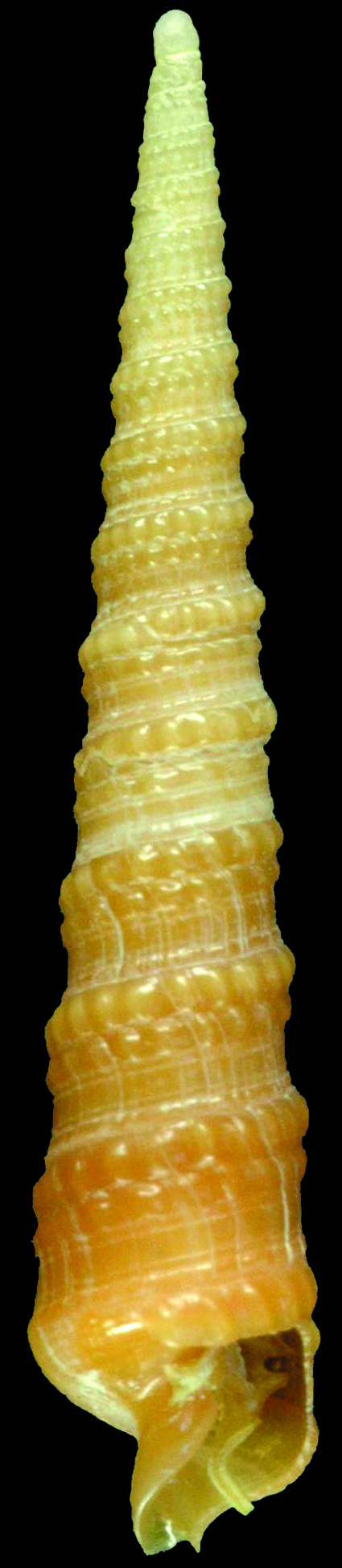
Description (holotype): White, elongated and rounded protoconch of about 2.0-2.5. Transition to protoconch gradual with appearance of axial sculpture. Overall base color generally orangish light brown. Outline of whorls concave, with a somewhat turreted outline because of the protruding double spiral row of nodules on and below the subsutural band. Axial sculpture from suture to suture, consisting of microscopic arcuate growth lines. Spiral sculpture on the subsutural band consisting of round nodules, which become axially elongated and flattened, separated by the axial growth lines. The sculpture is doubled below the subsutural band, although the nodules are there markedly smaller than on the subsutural band; separated from one another by a continuous incision. Spiral sculpture on the remainder of the whorl consisting of fine continuous incisions, giving an impression of raised bands. Spiral sculpture below the periphery of dense set ribblets. Columella curved, aperture elongate quadrate. Derivatio nominis: The species is named for its typical orangish-colored (latin: aurantiaca) shell.
Distribution
Type locality. Papua New Guinea, Expedition KAVIENG 2014 Stn KR18, Kavieng Lagoon, 02°35.1’S-150°47.3’E, 10 m. Distribution. From Palau to Fiji, including Papua New Guinea, Indonesia, Vanuatu and the Solomons, and possibly the Philippines.
Scientific Name Authorship
Terryn, Yves
Join the census
The Ocean Census Alliance unites national and philanthropic marine institutes, museums, and universities, backed by governments, philanthropy, business and civil society partners.


