















Species ID
OC-SP-0002621
Discovered
Phylum
Platyhelminthes
Species ID
OC-SP-0002621
Provisional Species Name
Cheliplana sp_IRLBB_01714
Lowest Valid Taxon Name in WoRMS
Cheliplana
Lowest Known Rank
Genus
Status
Discovered
Does the taxonomist(s) intend to work on this material further?
2. I/We already have plans to publish. (For marine invertebrates please know that SOSA could support you in this too - please click the button for more details).
Embargo
No
Kingdom
Animalia
Phylum
Platyhelminthes
Order
Rhabdocoela
Family
Cheliplanidae
Genus
Cheliplana
Taxonomic Remarks
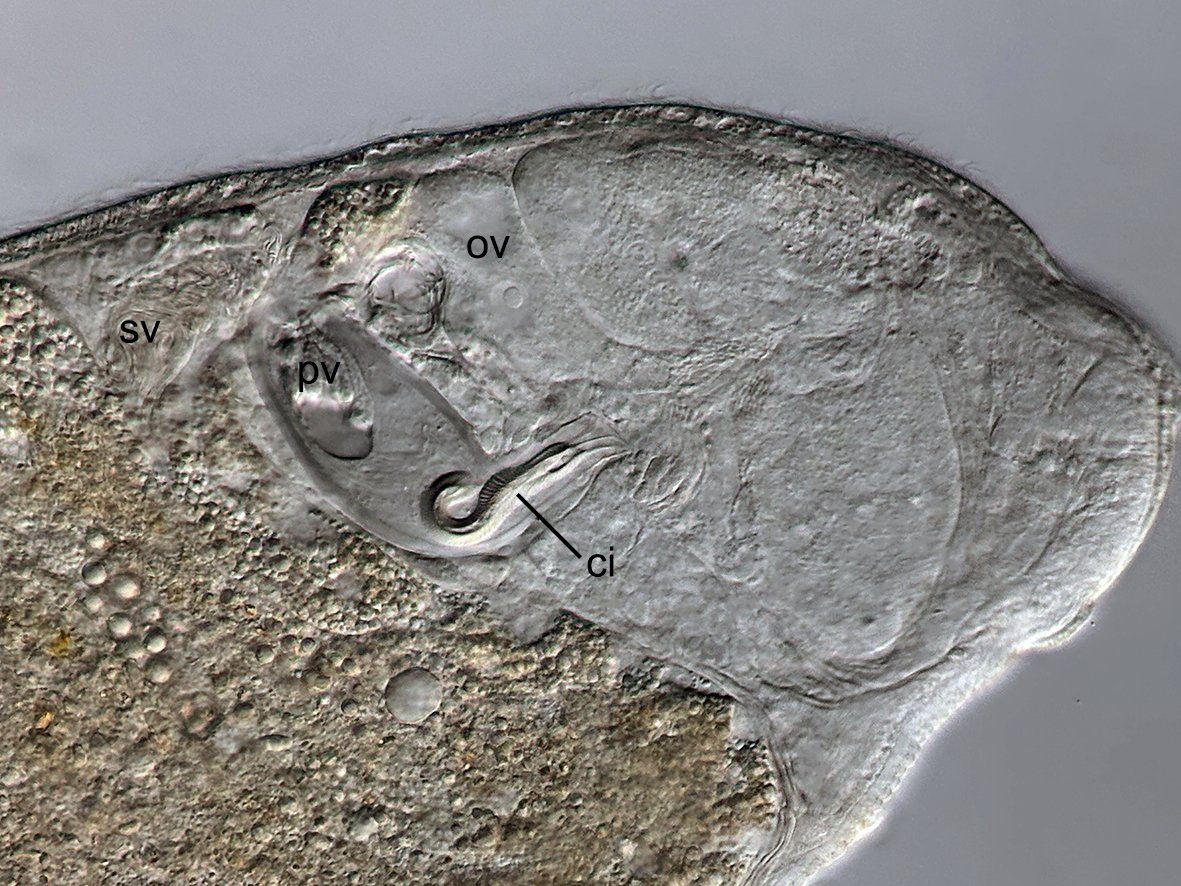
The previous discussion on Cheliplana sp.1 also applies to Cheliplana sp.2. This latter species is remarkable for its cirrus, which is shaped as such a question mark—a morphology unique within Cheliplana. Furthermore, the 60-µm-long cirrus of Cheliplana sp.2 is longer than in other related species, except for C. cubana (152 µm) and Cheliplana sp.1 (73–74 µm). The cirrus armature, consisting of spines measuring 4–5 µm proximally to medially and 2 µm distally, is another distinctive feature of this species.
Discovery registered on
01/04/2026
Description of Material
Species of Cheliplana with simple, 17-µm-long proboscis hooks; the hooks are almost straight, with the distal tips curved. The prepharyngeal cavity is covered by strong, needle-shaped spines. There is a single testis beside the pharynx. The atrial organs are in the posterior body third. There are two seminal vesicles. The cirrus is 60 µm long, proximally curved, and having the shape of a question mark. In the proximal 2/3 of the stylet, the spines are 4–5 µm long and distally are about 2 µm.
Ecology
Medium-grained and well-sorted sand, 10 m deep, salinity 37 ‰.
Distribution
United States of America, Florida, 6.75 km SE from the mouth of Fort Pierce Inlet, 27.429300; -80.241083.
Scientific Name Authorship
Diez, Yander L.
Join the census
The Ocean Census Alliance unites national and philanthropic marine institutes, museums, and universities, backed by governments, philanthropy, business and civil society partners.


