

























Species ID
OC-SP-0002180
Discovered
Phylum
Cnidaria
Species ID
OC-SP-0002180
Provisional Species Name
Phialoba sp_OCCNI40
Lowest Valid Taxon Name in WoRMS
Phialoba
Lowest Known Rank
Genus
Status
Discovered
Does the taxonomist(s) intend to work on this material further?
2. I/We already have plans to publish. (For marine invertebrates please know that SOSA could support you in this too - please click the button for more details).
Kingdom
Animalia
Phylum
Cnidaria
Class
Hexacorallia
Order
Actiniaria
Family
Actiniidae
Genus
Phialoba
Date Identified
12/01/2026
Taxonomic Remarks
Phialoba sp. exhibits a tentacular arrangement similar to that of Phialoba steinbecki (family Actiniidae), with marginal tentacles arranged in alternating cycles (one tentacle per endo- and exocoel), as well as discal tentacles reduced to protuberances arranged in radial rows on the oral disc. However, Phialoba sp. differs from P. steinbecki in having conspicuous marginal projections on the upper part of the column, whereas P. steinbecki lacks such projections. In addition, Phialoba (?) sp. has 96 marginal tentacles, whereas those of P. steinbecki are much more numerous, reaching approximately 380 tentacles. Likewise, P. steinbecki exhibits a significantly higher number of mesenteries distally than proximally, whereas in Phialoba (?) sp. the number of mesenteries is the same at both distal and proximal ends. We compared genetic sequences of Phialoba (?) sp. corresponding to the mitochondrial markers 12S, 16S, and COX3 with those of representatives of the main groups within the superfamily Endomyaria, and particularly of the family Actiniidae; however, it was not possible to obtain sequences of P. steinbecki. The results suggest that Phialoba (?) sp. is closely related to Phymanthus crucifer, a species distributed in the Caribbean and the Gulf of Mexico. Interestingly, P. crucifer is the only species of the genus Phymanthus (family Phymanthidae) that has repeatedly been found, from a phylogenetic perspective, to be nested among species of the family Actiniidae. Phymanthus crucifer also exhibits marginal and discal tentacles, as well as marginal projections on the upper part of the column. However, unlike Phialoba (?) sp. and P. steinbecki, P. crucifer bears verrucae on the column arranged in longitudinal rows. In summary, Phialoba (?) sp. exhibits morphological characters intermediate between Phialoba steinbecki and Phymanthus crucifer. We are currently obtaining sequences of additional genetic markers to further elucidate the relationships among these species and to evaluate whether Phialoba (?) sp. shows broader genetic divergence that could even justify the erection of a new genus.
Received All Minimal Data for Discovery
20/02/2026
Description of Material
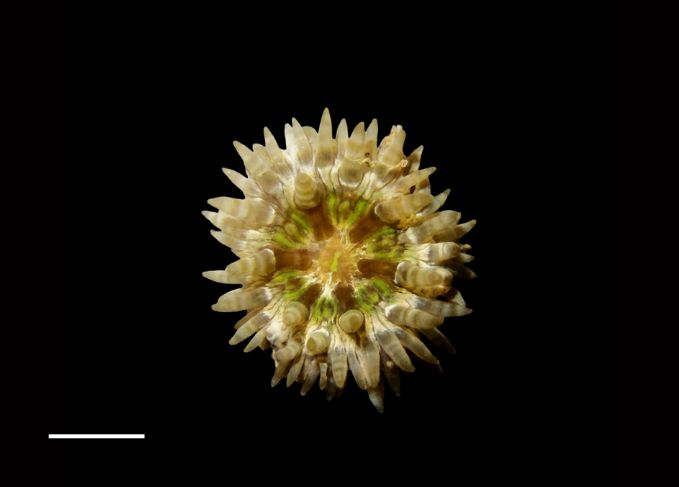
Pedal disc well developed. Column smooth, without ornamentation. Pedal disc and column pale beige to whitish. Distal end of the column bearing a ring of 48 conspicuous endocoelic marginal projections. Fosse well marked. Oral disc white with dark-brown bands in the spaces of the first endocoelic cycle and bright or olive-green flashes in the remaining endocoelic cycles. Marginal tentacles short, conical, greyish or beige, translucent, usually smooth but with transverse white ridges on the oral side; tentacles arranged hexamerously in five cycles (96 in number). Discal tentacles very reduced, papilliform, arranged in radial rows (1–3 discal tentacles per row) in the endocoelic spaces of the first, second, and occasionally the third cycle of tentacles. Mesenteries arranged hexamerously in four cycles (48 pairs in the specimens examined): only the first cycle perfect; same number of mesenteries distally and proximally. Two pairs of directive mesenteries, each associated with a well-developed siphonoglyph. Stronger mesenteries of the first two cycles fertile, except directives; species gonochoric (?), with only poorly developed oocytes observed in the specimens examined. Retractors strong and restricted; parietobasilar muscles well developed, with a free mesogleal pennon. Basilar muscles well developed. Endodermal marginal sphincter muscle poorly developed, very weak and diffuse. Longitudinal muscles of tentacles ectodermal. Zooxanthellate. Cnidom: basitrichs, spirocysts, and p-mastigophores.
Ecology
Phialoba sp. was found firmly attached to rocks, inside cracks and crevices, in the reef lagoon zone, between 0.5 and 2 m depth.
Distribution
Phialoba sp. is distributed in the southern Gulf of Mexico, on reefs of the Veracruz Reef System, and in Alacranes Reef National Park, Yucatán, Mexico. In addition, this species was observed in Mochima National Park, Venezuela.
Scientific Name Authorship
Ricardo González Muñoz, Estefanía Rodríguez, Camila Vasquez Sasali, Fabián H. Acuña & Agustín Garese
Specimens
Join the census
The Ocean Census Alliance unites national and philanthropic marine institutes, museums, and universities, backed by governments, philanthropy, business and civil society partners.


