






















Species ID
OC-SP-0002179
Discovered
Phylum
Cnidaria
Species ID
OC-SP-0002179
Provisional Species Name
Parantheopsis sp_OCCNI25
Lowest Valid Taxon Name in WoRMS
Parantheopsis
Lowest Known Rank
Genus
Status
Discovered
Does the taxonomist(s) intend to work on this material further?
2. I/We already have plans to publish. (For marine invertebrates please know that SOSA could support you in this too - please click the button for more details).
Kingdom
Animalia
Phylum
Cnidaria
Class
Hexacorallia
Order
Actiniaria
Family
Actiniidae
Genus
Parantheopsis
Date Identified
09/01/2026
Taxonomic Remarks
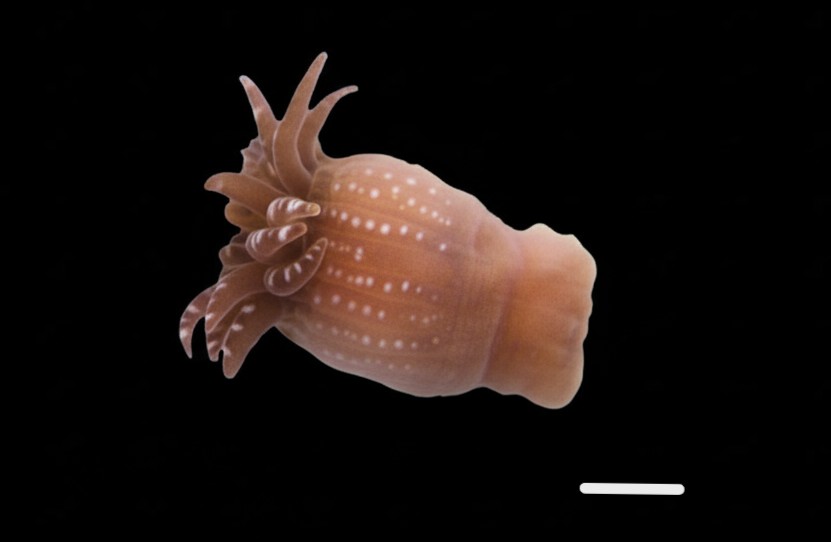
The genus Parantheopsis currently comprises four valid species: P. cruentata, P. georgiana, P. ocellata, and P. vanhoeffeni. Parantheopsis sp. has approximately 48 tentacles, a number similar to that of P. cruentata and P. vanhoeffeni, whereas P. ocellata has 90–96 tentacles and P. georgiana has 40–41. Parantheopsis ocellata and P. cruentata possess a weak and diffuse sphincter, and P. vanhoeffeni has a circumscribed sphincter, while P. georgiana lacks a sphincter, as does Parantheopsis sp. Parantheopsis vanhoeffeni is the only species documented as hermaphroditic; so far, only oocytes have been recorded in specimens of Parantheopsis sp., suggesting that it is probably a gonochoric species. In Parantheopsis sp., adhesive verrucae clearly extend only to the middle part of the column, whereas in the other species the distribution of verrucae is unknown, except in P. ocellata, in which the number of longitudinal rows of verrucae gradually decreases from the apical to the basal end. In addition to these differences and variation in coloration, no other species of Parantheopsis has been documented with a tentacle coloration pattern similar to that of Parantheopsis sp., which is characterized by a series of whitish spots or dots extending along almost the entire length of the tentacle on the oral side.
Received All Minimal Data for Discovery
20/02/2026
Description of Material
Pedal disc approximately 15–20 mm in diameter. Column about 15 mm in diameter and 15–20 mm in height. Column with longitudinal rows of adhesive verrucae extending from the margin to one third or up to half of its length. Distal column with marginal projections, without acrorhagi. Tentacles generally short, conical, slender, about 48 in number. Column beige, greenish, or light pink in color, varying from darker distally to lighter proximally. Tentacles greenish-gray, red, or whitish, with a series of bands. Each tentacle bears a series of spots or transverse bands relative to the tentacle axis, extending along almost its entire length. Oral disc also variable in color, ranging from pink, green, brown, or white. Mesenteries arranged hexamerously in three cycles, 23–24 pairs in number. Two pairs of directives, each with a well-developed siphonoglyph. Gametogenic tissue present on the stronger mesenteries of the three cycles, except on the directives. Retractor muscles strong and restricted; parietobasilar muscles well developed. Basilar muscles well developed. Marginal sphincter muscle absent. Tentacle longitudinal muscles ectodermal.
Ecology
Parantheopsis sp. is commonly found under rocks in the intertidal zone, in tide pools.
Distribution
Intertidal zone. Puerto San Julián, Santa Cruz Province, Argentina ( 49°20′S, 67°66′W). Puerto Deseado, Santa Cruz Province (47°45'S, 65°51'W).
Scientific Name Authorship
Ricardo González Muñoz, Fabián H. Acuña, Camila Vasquez Sasali & Agustín Garese
Specimens
Join the census
The Ocean Census Alliance unites national and philanthropic marine institutes, museums, and universities, backed by governments, philanthropy, business and civil society partners.


