













Species ID
OC-SP-0002177
Discovered
Phylum
Cnidaria
Species ID
OC-SP-0002177
Provisional Species Name
Sagartiogeton sp_OCCNI08
Lowest Valid Taxon Name in WoRMS
Sagartiogeton
Lowest Known Rank
Genus
Status
Discovered
Does the taxonomist(s) intend to work on this material further?
2. I/We already have plans to publish. (For marine invertebrates please know that SOSA could support you in this too - please click the button for more details).
Kingdom
Animalia
Phylum
Cnidaria
Class
Hexacorallia
Order
Actiniaria
Family
Sagartiidae
Genus
Sagartiogeton
Date Identified
20/01/2026
Taxonomic Remarks
The genus Sagartiogeton comprises eleven valid species. Sagartiogeton sp. presents a smooth column, lacking a well-developed cuticle and specialized structures such as cinclides or tenaculi. Within the genus, only S. californicus, S. rufus, and S. abyssorum share this smooth column condition. Although the absence of tenaculi could suggest affinity with Sagartia, molecular studies clearly separate the clades Sagartia and Sagartiogeton, and demonst rate that Sagartiogeton californicus, Sagartiogeton rufus, and Sagartiogeton awii, belongs to the same genus, characterized by strongly cuticulated tenaculi. Sagartiogeton sp. and S. californicus differ clearly from S. rufus, which is a small-sized species with thin body walls and mesoglea approximately 130 µm thick in the folds, whereas in the former two species the mesoglea exceeds 500 µm. Sagartiogeton sp. and S. californicus share a more robust column and orange-reddish coloration; tentacles are similar in color to the column or darker, each bearing a whitish basal ring. However, S. californicus differs from Sagartiogeton sp. by the presence of cinclides in the distal region of the scapus and by bilobed retractor muscles in first-order mesenteries. Additionally, S. californicus is a deep-sea species distributed in the North Pacific (northeastern Pacific) and primarily associated with chemosynthetic environments, particularly methane seeps. S. abyssorum shares the smooth column condition with Sagartiogeton sp.; however, it differs by having more than 12 pairs of perfect mesenteries, and retractor muscles occupying most of the mesenterial length, attached in a diffuse to more circumscribed manner forming a lateral band. Furthermore, S. abyssorum inhabits deep waters off Iceland. Sagartiogeton sp. and S. scotiae are the only two species of the genus recorded from the South Atlantic Ocean. Sagartiogeton sp. was recorded in the Área Marina Protegida Namuncurá–Banco Burdwood at depths between 474 m and 580 m, whereas S. scotiae has been recorded from waters surrounding South Georgia and the South Sandwich Islands, as well as the Antarctic Peninsula, at considerably greater depths, between 2852 and 3239 m. Both species clearly differ in external anatomy. S. scotiae possesses cuticulated tenaculi with small adhered sand grains and numerous cinclides, reaching up to 50 per specimen, absent in Sagartiogeton sp.
Received All Minimal Data for Discovery
20/02/2026
Description of Material
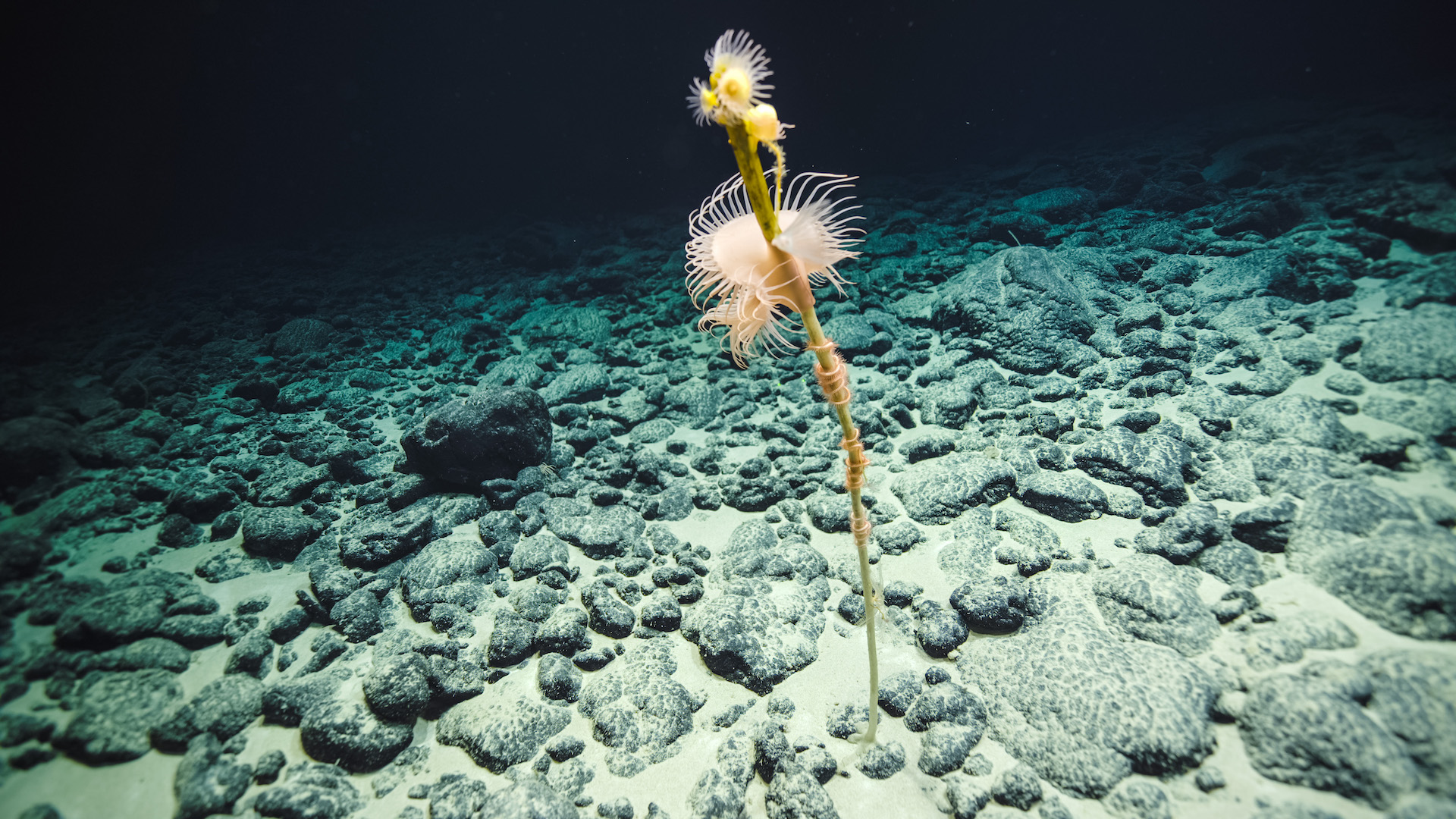
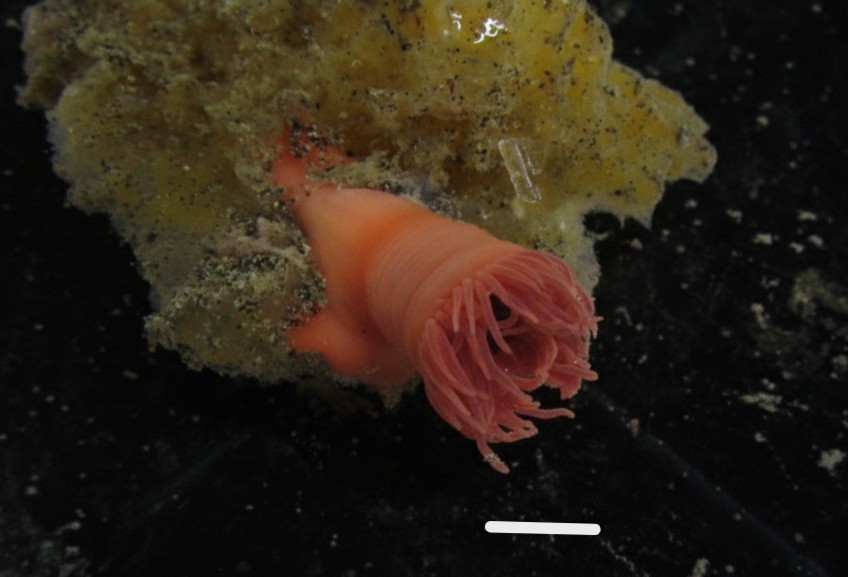
Pedal disc oval to irregular, more or less expanded, covered by a well-developed cuticle, up to 19 mm in basal diameter in preserved specimens. Column cylindrical and soft, not divided into scapus and scapulus, up to 23 mm in length and 13 mm in diameter in preserved specimens; when contracted maintaining cylindrical shape with irregular wrinkles appearing as transverse folds. Margin tentaculate. Oral disc with prominent lips surrounding a central mouth bearing two distinct siphonoglyphs, 2 mm in diameter. Tentacles numerous, 86–100, arranged in at least four cycles, generally filiform; outer tentacles slightly shorter than inner ones; completely retractile. Acontia present, expelled through the mouth. Cinclides not observed. Live specimens with orange-reddish column. Tentacles similar in color to the column or darker, each with a whitish basal ring. Preserved specimens externally whitish, internally with dark brown actinopharynx. Mesenteries 24 pairs at the level of the actinopharynx; first twelve pairs perfect, corresponding to the first and second cycles, remaining pairs belonging to a third imperfect cycle; in the coelomic cavity a fourth cycle in development, represented by ten pairs of small mesenteries. Two pairs of directive mesenteries, each associated with a siphonoglyph. Retractor muscles well developed in first and second cycles, restricted to circumscribed. Mesenterial filaments trilobed, terminating in acontia. One specimen with numerous oocytes, up to 112 µm in diameter, present from the first cycle, possibly to the third cycle. Basilar muscles weakly developed. Parietobasilar muscles weakly developed, evident in directive mesenteries and in a few first-cycle mesenteries. Marginal sphincter mesogleal, strong and diffuse, in the distal region occupying almost the entire mesoglea. Longitudinal muscles of the tentacles ectodermal. Cnidom comprising spirocysts, basitrichs, microbasic p-mastigophores, and mesobasic p-mastigophores.
Ecology
Sagartiogeton sp. has been collected at depths between 474 and 580 m, living on sponges.
Distribution
MPA Namuncurá Banco Burdwood, 54º53,26’S, 59º53,06’O. Depth (580 m).
Scientific Name Authorship
Camila Vasquez Sasali, Ricardo González Muñoz, Fabián H. Acuña & Agustín Garese
Join the census
The Ocean Census Alliance unites national and philanthropic marine institutes, museums, and universities, backed by governments, philanthropy, business and civil society partners.


