












SA - Point Souttar - 4m;31 - Nemertea;BQCAB0030;SACReD08-LA05;Notospermus sp. SMSA098;SMSA098;SP02352;AN014227;NMVE9278;PID0087050
SA - Point Souttar - 4m;31 - Nemertea;BQCAB0030;SACReD08-LA05;Notospermus sp. SMSA098;SMSA098;SP02352;AN014227;NMVE9278;PID0087050
Species ID
OC-SP-0002946
Discovered
Phylum
Nemertea
Species ID
OC-SP-0002946
Provisional Species Name
Notospermus sp_SMSA098
Lowest Valid Taxon Name in WoRMS
Notospermus
Lowest Known Rank
Genus
Status
Discovered
Does the taxonomist(s) intend to work on this material further?
3. I/We are not sure yet. This is of course no problem, we will display your species info (if not embargoed) while you work out your species description plan.
Embargo
No
Kingdom
Animalia
Phylum
Nemertea
Class
Pilidiophora
Order
Heteronemertea
Family
Lineidae
Genus
Notospermus
Date Identified
21/01/2026
Taxonomic Remarks
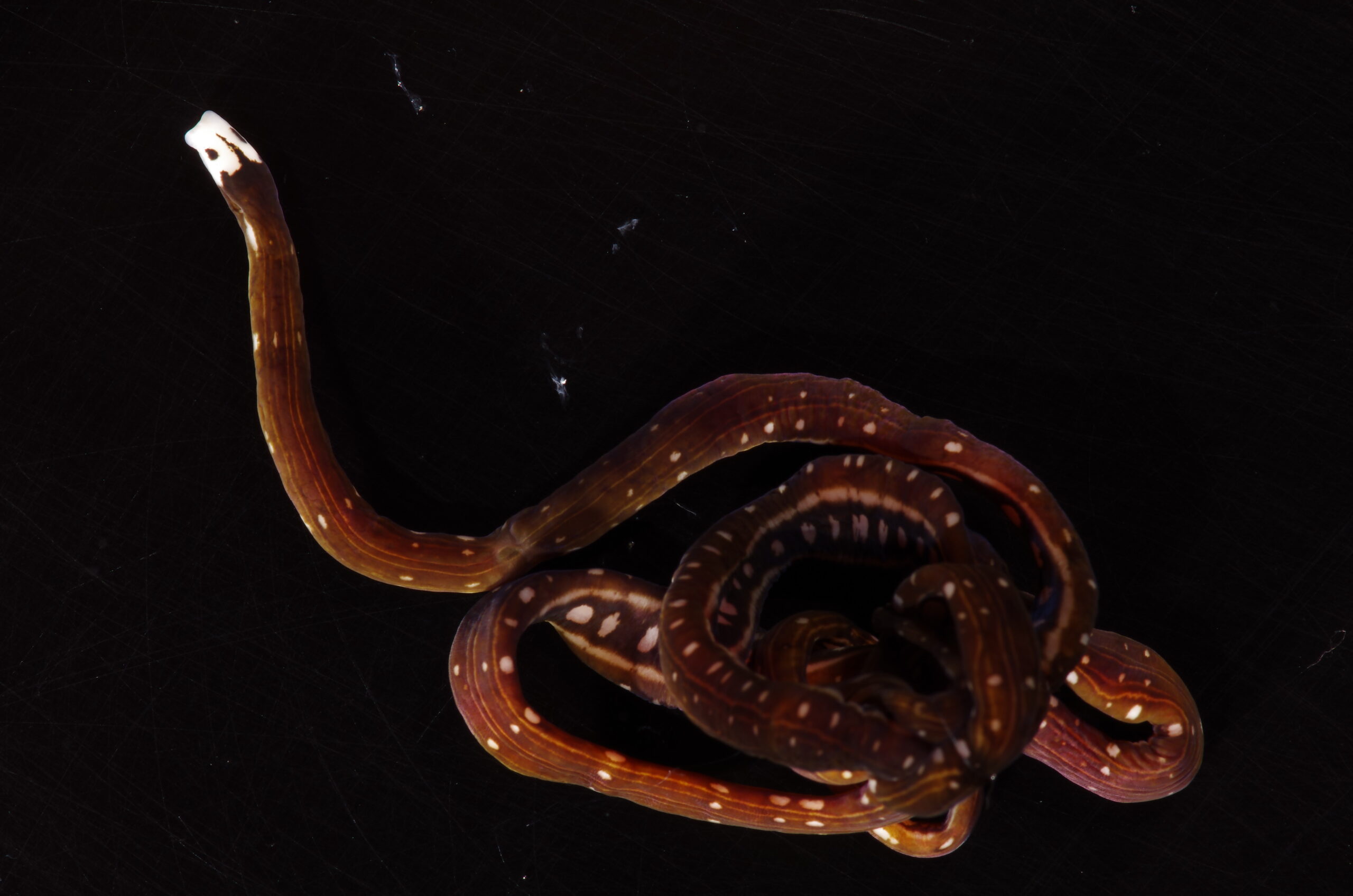
Resembles other species of Notospermus in shape of body and cephalic lobe, and in having a contrasting pattern of white on brown (or other dark) background, but the pattern of longitudinal lines and white spots is unique and characteristic. May be related to Australienus albidecus described by Gibson (1990) from the Albany region of Western Australia, which likely belongs to Notospermus, but the latter species has more white ventrally, only two lighter colored longitudinal dorsal lines, a pattern of white diamond-shapes, and the background color is described as black, rather than brown. Furthermore, Western Australia represents a distinct biogeographic province from Southeast Australia, with little overlap in species composition, thus this species is considered to be likely new. The present species is quite divergent in its COI sequence from all other barcoded Notospermus spp.
Discovery registered on
08/04/2026
Description of Material
Body 250 mm long, 4 mm wide, dorso-ventrally flattened and widest in the midgut region, more cylindrical and slender in the foregut region, without a caudal cirrus. Background colour sepia brown to dark brown dorsally and ventrally; with a striking pattern of three pairs of thin longitudinal cinnamon to caramel lines: one mid-dorsal, and two dorso-lateral, in addition to the two thicker ventro-lateral longitudinal white lines. Most strikingly, the body is decorated with a series of white spots (round or oval, or less regular in shape), which are arranged to form more or less regular transverse “rings” along the entire length of body. The ventral side bears a single elongated white area immediately posterior to mouth, followed by a longitudinal row of large white spots between the two ventro-lateral white lines. Laterally, on each side there is a single row of smaller white spots between the white ventro-lateral line and the dorso-lateral pair of cinnamon-caramel lines. The dorsal side bears two rows of white spots located between the three pairs of cinnamon-caramel lines (one row on each side of the mid-dorsal pair of cinnamon lines). Thus each transverse “ring” is composed of five separate white spots. Together the longitudinal lines and the “rings” comprise a unique and striking color pattern. Cephalic lobe sub-rectangular, about twice as long as it is wide. The anterior margin notched. With 15-20 small ocelli on each side of head along the anterior margin and cephalic slits. Dorsally and ventrally anterior-most half of cephalic lobe is pure white, with two not-quite symmetrical elongated patches of dark brown and an intruding forward-pointing tall mid-dorsal peak of background color.
Ecology
Found by diver at 4 m, entwined in a rock.
Distribution
Currently only known from Point Souttar, South Australia, Australia.
Scientific Name Authorship
Maslakova, Svetlana
SA - Point Souttar - 4m;31 - Nemertea;BQCAB0030;SACReD08-LA05;Notospermus sp. SMSA098;SMSA098;SP02352;AN014227;NMVE9278;PID0087050
SA - Point Souttar - 4m;31 - Nemertea;BQCAB0030;SACReD08-LA05;Notospermus sp. SMSA098;SMSA098;SP02352;AN014227;NMVE9278;PID0087050
Join the census
The Ocean Census Alliance unites national and philanthropic marine institutes, museums, and universities, backed by governments, philanthropy, business and civil society partners.


