











Species ID
OC-SP-0002664
Discovered
Phylum
Platyhelminthes
Species ID
OC-SP-0002664
Provisional Species Name
Yorknia sp_S_1903
Lowest Valid Taxon Name in WoRMS
Yorknia
Lowest Known Rank
Genus
Status
Discovered
Does the taxonomist(s) intend to work on this material further?
2. I/We already have plans to publish. (For marine invertebrates please know that SOSA could support you in this too - please click the button for more details).
Embargo
No
Kingdom
Animalia
Phylum
Platyhelminthes
Order
Proseriata
Family
Yorkniidae
Genus
Yorknia
Taxonomic Remarks
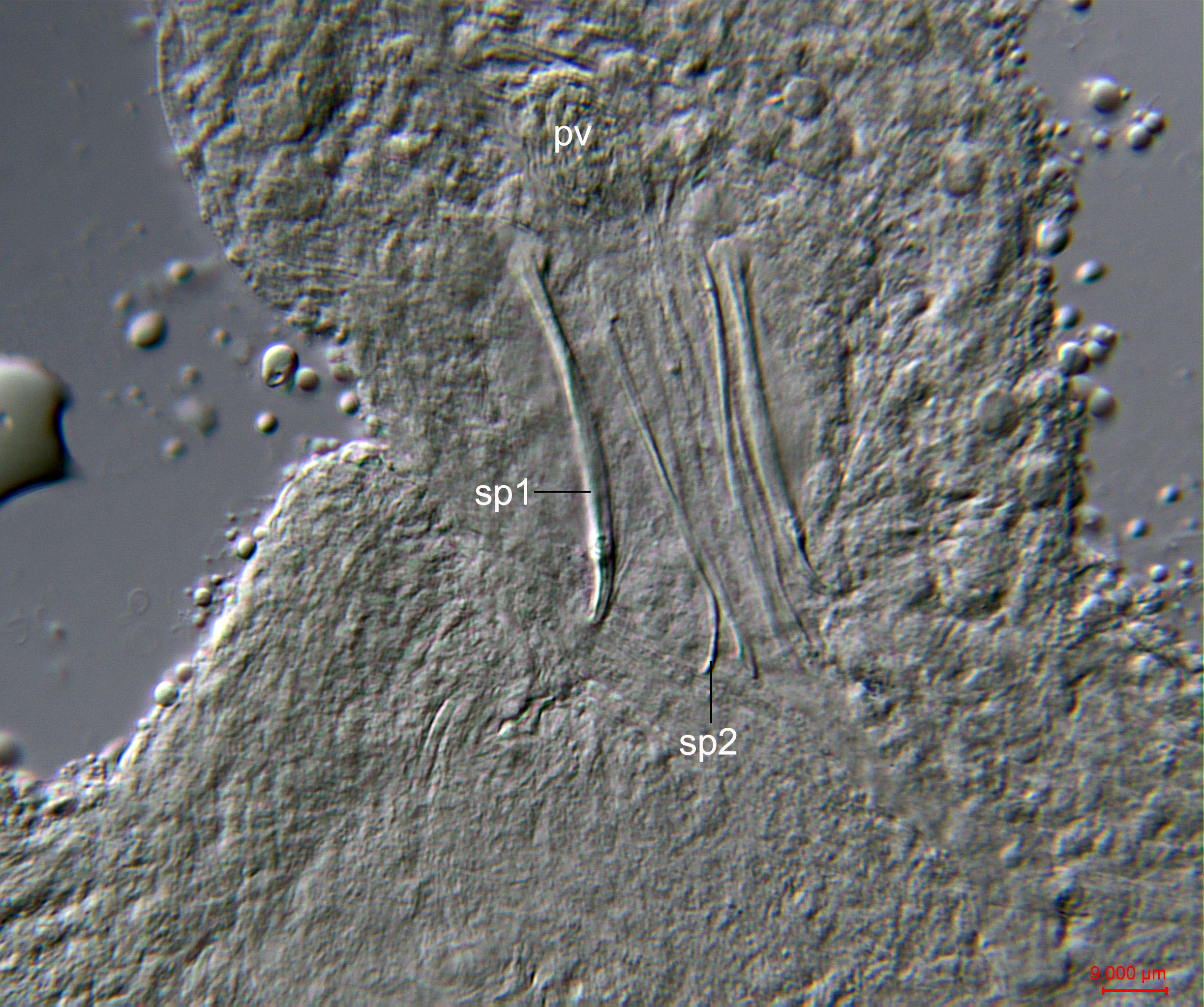
Species of Yorkniidae and its single contained genus Yorknia are differentiable from other proseriate microturbellarians because present a non-encapsulated brain, a short distance anterior to the statocyst, a female pore located immediately after and bursal pore anterior to the male pore, the lack of a prostatoid organ, and a male copulatory bulb containing a stylet, spines or their combination. All these characteristics were confirmed in Yorknia sp.1. Until now, seven species of Yorknia are known and they are differentiable by the presence of bursal pore converging with the male pore or separated, and the morphology of the sclerotized structures of the male bulb. Yorknia sp.1 is, therefore, comparable with the single other species with male and bursal pores separated and containing only spines within the male bulb: Y. schockaerti. Yorknia sp.1 is remarkable different from Y. schockaerti because presents two different types of spines: eight needle-shaped spines forming a ring surrounding the ejaculatory duct and two strong spines flanking the ring of spines. Otherwise, Y. schockaerti only present a ring of 21 spines.
Discovery registered on
01/04/2026
Description of Material
Species of Yorknia with the male pore separated from the female bursal pore. The male organs are oriented forwards. A poorly muscular seminal vesicle opens proximally into the male bulb. The male bulb contains two types of spines. There is a pair of spines type 1, with are located at the sides of the bulb, are much stronger than the others, end in a distal hook with sharp tip, and measure 51–52 µm long (n = 4). There are eight spines type 2 forming a ring in between the spines type 1. They are needle-shaped, with the distal part curved and ending on blunt tip, measuring 55–57 µm long (x¯ = 56 µm; n = 10).
Distribution
United States of America, Florida, Fort Pierce, Old Ford Park, 27.437535; -80.319533.
Scientific Name Authorship
Diez, Yander L.
Join the census
The Ocean Census Alliance unites national and philanthropic marine institutes, museums, and universities, backed by governments, philanthropy, business and civil society partners.


