
















Species ID
OC-SP-0002648
Discovered
Phylum
Platyhelminthes
Species ID
OC-SP-0002648
Provisional Species Name
Schizorhynchidae sp_IRLBB_01210
Lowest Valid Taxon Name in WoRMS
Schizorhynchidae
Lowest Known Rank
Family
Status
Discovered
Does the taxonomist(s) intend to work on this material further?
2. I/We already have plans to publish. (For marine invertebrates please know that SOSA could support you in this too - please click the button for more details).
Embargo
No
Kingdom
Animalia
Phylum
Platyhelminthes
Order
Rhabdocoela
Family
Schizorhynchidae
Taxonomic Remarks
Schizorhynchidae sp.3 is readily distinguished by its brownish pigmentation, anteriorly positioned pharynx, and reduced proboscis. Epidermal pigment granules have previously been reported only in species of Carcharodorhynchus. However, members of Carcharodorhynchus are characterised by proboscis lips carrying teeth—a condition unique within Schizorhynchidae—and are therefore easily distinguishable from Schizorhynchidae sp.3. As discussed above, the extremely anterior position of the pharynx observed in this species is highly unusual within Schizorhynchia, as is the placement of the testes anterior to the pharynx and immediately posterior to the proboscis. The male copulatory bulb does not exhibit any distinctive features when compared with other schizorhynchs, and, unfortunately, the female reproductive system could not be examined in detail. Consequently, this combination of characters supports the recognition of Schizorhynchidae sp.3 as a new species within the family; however, its assignment to an existing genus is currently precluded by the limited material available.
Discovery registered on
01/04/2026
Description of Material
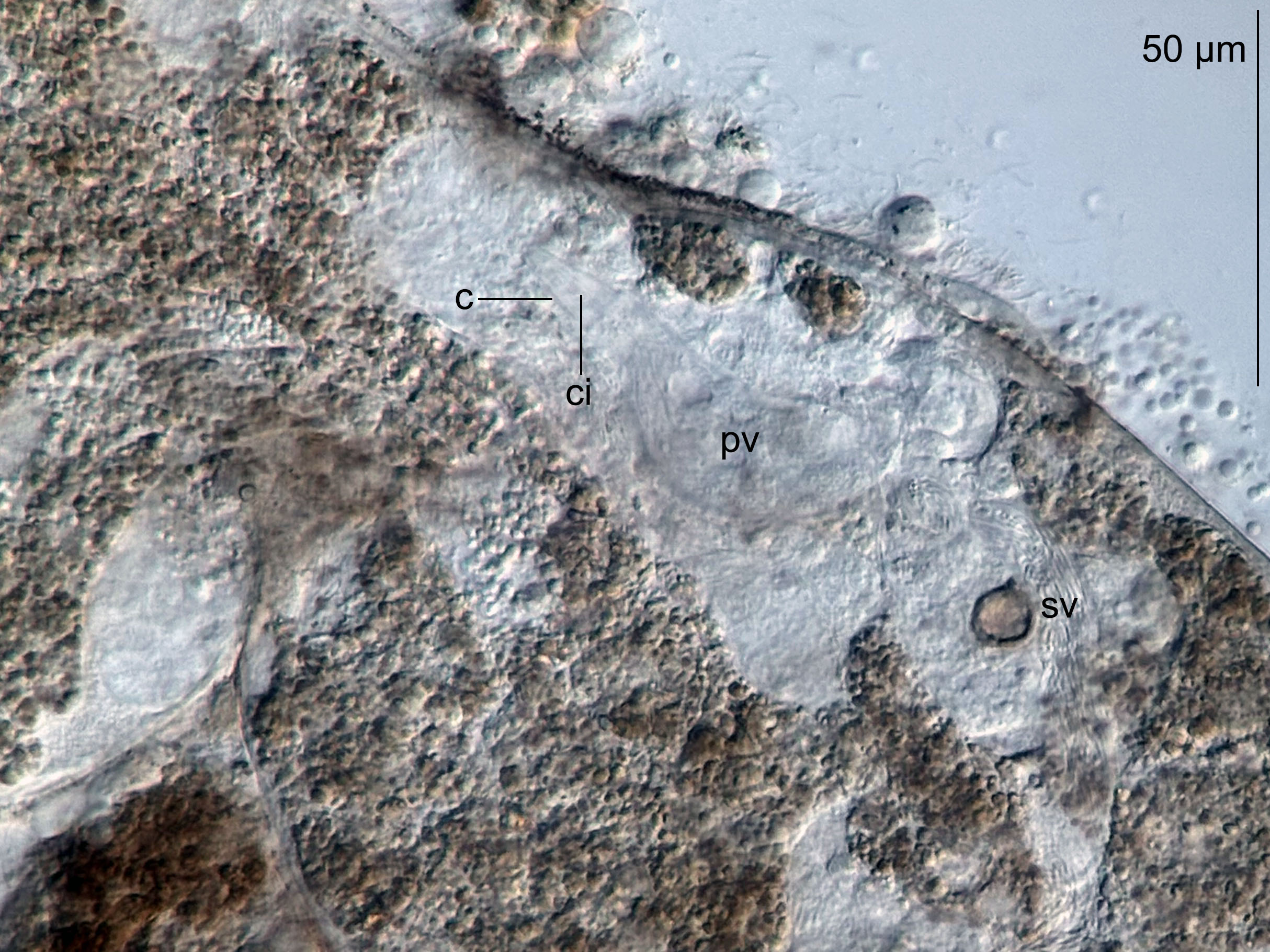
Species of Schizorhynchidae with a brownish pigmentation caused by the accumulation of pigment granules in the epidermis. Two adhesive belts are distinguished, one subterminal and one posterior to the pharynx. Proboscis small, with symmetric lips, without posterior glands sheathed by muscles. Eyes absent. A pair of testes anterior to the pharynx; testes located at the body sides. Atrial organs located in the posterior third of the body. The male bulb receives the seminal vesicles and encompasses the prostate vesicle, a delicate cirrus, and ends in a sclerotised cap. The cirrus seems to contain very delicate spines, which are not measurable in the available material. The cap is 13–14 µm long (n = 2). Ovary and bursa located posterior to the male system; however, their connections where not distinguished.
Ecology
Shell hash, well-sorted, 1 m deep, salinity 37 ‰.
Distribution
United States of America, Florida, Jupiter, Dubois Park, 26.942900; -80.073280.
Scientific Name Authorship
Diez, Yander L.
Join the census
The Ocean Census Alliance unites national and philanthropic marine institutes, museums, and universities, backed by governments, philanthropy, business and civil society partners.


