


























Species ID
OC-SP-0002174
Discovered
Phylum
Cnidaria
Species ID
OC-SP-0002174
Provisional Species Name
Bunodactis sp_OCCNI14
Lowest Valid Taxon Name in WoRMS
Bunodactis
Lowest Known Rank
Genus
Status
Discovered
Does the taxonomist(s) intend to work on this material further?
2. I/We already have plans to publish. (For marine invertebrates please know that SOSA could support you in this too - please click the button for more details).
Embargo
No
Kingdom
Animalia
Phylum
Cnidaria
Class
Hexacorallia
Order
Actiniaria
Family
Actiniidae
Genus
Bunodactis
Date Identified
11/12/2025
Taxonomic Remarks
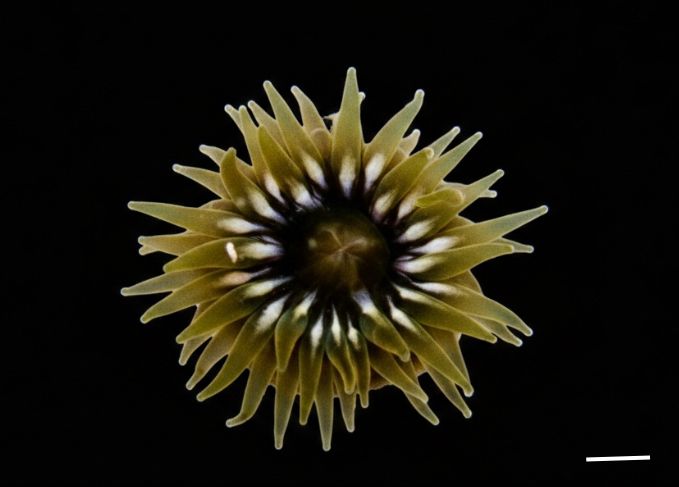
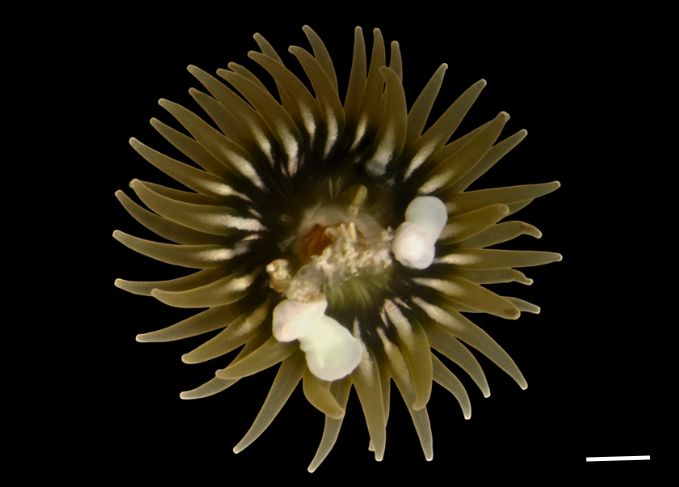
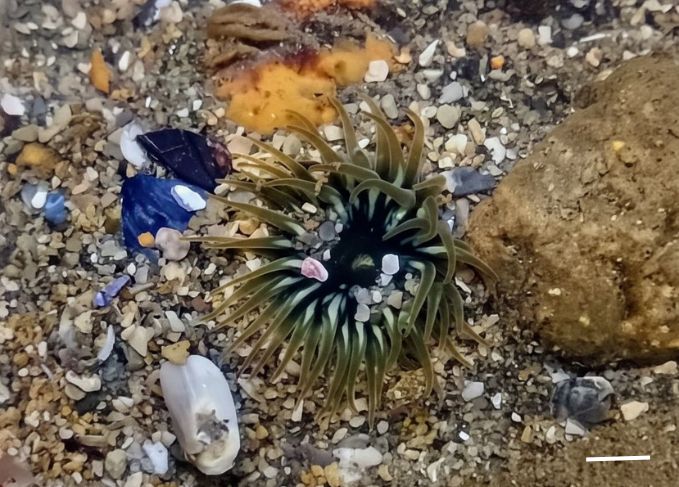
The genus Bunodactis currently includes twenty valid species. Bunodactis sp. presents diagnostic characteristics of the genus Bunodactis, such as adhesive verrucae on the column and a margin lacking acrorhagi, as well as its cnidom. This species closely resembles Bunodactis octoradiata, which inhabits the same region, as both share octamerous symmetry, the presence of columnar verrucae, and a similar body size. In addition, B. octoradiata is a brooding species, and Bunodactis sp. apparently shares this reproductive trait. Despite these similarities, both species differ mainly in their coloration patterns. Bunodactis octoradiata exhibits an intense red coloration on the tentacles and oral disc, with a central yellow ring surrounding the mouth, whereas Bunodactis sp. is olive green, with a dark green oral disc and white spots at the base of the tentacles. Moreover, Bunodactis sp. possesses more than 60 tentacles and 32–33 pairs of mesenteries, while B. octoradiata has 28–32 tentacles and 16 pairs of mesenteries. Differences are also observed in the musculature. Bunodactis sp. has strong, diffuse retractor muscles and a slightly pinnate circumscribed sphincter muscle, whereas B. octoradiata presents restricted retractors and a palmate circumscribed sphincter muscle. Additionally, B. octoradiata has two siphonoglyphs, while Bunodactis sp. apparently presents only one.
Discovery registered on
20/02/2026
Description of Material
Pedal disc approximately 10–15 mm in diameter. Column approximately 10 mm in diameter and 10–12 mm in height. Fixed specimens with the pedal disc wider than the column and the oral disc. Column with longitudinal rows of adhesive verrucae extending from the margin to the limbus. Distal column with marginal projections, although lacking acrorhagi. Tentacles generally short, conical, slender, approximately 60–66 in number. Column and tentacles olive green in color, oral disc dark green. Each tentacle with a white spot at the basal region on the oral side. Mesenteries apparently arranged octamerously, with 32–33 pairs distributed in four cycles (8 + 8 + 8 + 9). Two pairs of directive mesenteries, but apparently only one siphonoglyph. Retractor muscles strong and diffuse; parietobasilar and basilar muscles well developed. Marginal sphincter muscle circumscribed, slightly pinnate. Longitudinal muscles of the tentacles ectodermal.
Etymology
N/A
Ecology
Bunodactis sp. occurs in patches with numerous individuals. Found attached to rocks in tide pool areas. Juvenile individuals were observed emerging from the mouth, which apparently had been brooded within the parent individual.
Distribution
Intertidal zone, Puerto San Julián, Santa Cruz Province, Argentina ( 49°20′S, 67°66′W).
Scientific Name Authorship
Agustín Garese, Ricardo González Muñoz, Camila Vasquez Sasali & Fabián H. Acuña
Join the census
The Ocean Census Alliance unites national and philanthropic marine institutes, museums, and universities, backed by governments, philanthropy, business and civil society partners.


