









67 new auger snail species discovered
by Belgian conchologist, Yves Terryn:
A milestone in Terebridae taxonomy

Finding beauty in snail shells
The Ocean Census is proud to celebrate the extraordinary achievement of Belgian conchologist Yves Terryn, who has discovered 67 new species of auger snails (family Terebridae) through work supported by the Ocean Census Species Discovery Awards.
This remarkable leap forward brings crucial clarity to a beautiful group of marine gastropods, and highlights the power of investment in taxonomy to accelerate global species discovery.
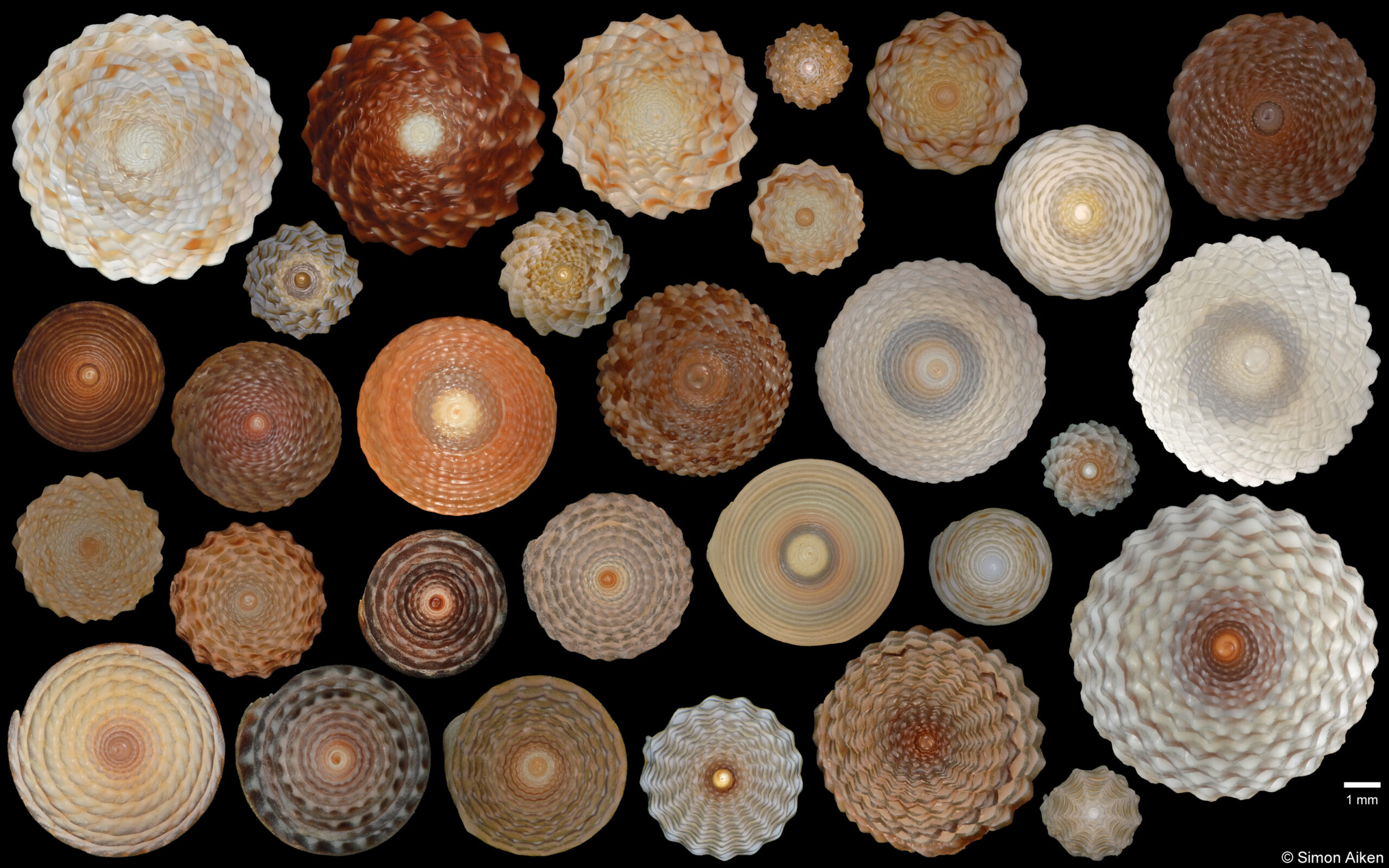
Featured image credits: Dr Simon Aiken (UK)
What are Terebridae?
Terebridae – also known as terebras, auger shells or marlin spikes – are a family of predatory marine gastropods. They live in on intertidal lagoons, sand bars, coral reefs, and deep-water habitats reaching nearly 1,000 metres.
Recognisable by their slender, high-spired shells that resemble a rock drill bit, terebrids belong to the superfamily Conoidea, and possess complex venoms and diverse anatomies. Their traits make them scientifically valuable, yet historically difficult to classify.
Modern revisions have transformed our understanding of the group. Thanks to new molecular phylogenies and improved approaches to speciation and shell morphology, the family has recently been subdivided into three subfamilies and 20 genera, with roughly 580 to 650 species recognised today. That number continues to rise – rapidly – thanks to dedicated taxonomists like Yves.

Myurella pygmaea. Photo credits: David Massemin
A breakthrough discovery: 67 new species
With support from Ocean Census funding in 2025, Yves completed a major study of material from:
- historic and modern institutional collections,
- private collections,
- shallow-water cryptic groups, and
- rare deep-water samples from regions including Taiwan, Papua New Guinea, New Caledonia’s EEZ, and remote Pacific islands.
This effort led to the discovery of 67 new species of auger snails. A significant advance for a family long overdue for revision.
“These discoveries represent another giant leap forward in our understanding of diversity in this fascinating family,” Yves explains. The work not only adds new species to the global registry, but also helps clarify complex species groups, resolve long-standing taxonomic uncertainties, and fill phylogenetic knowledge gaps.
Yves emphasises that the greatest remaining potential for new discoveries lies both in shallow-water cryptic species and in habitats beyond standard SCUBA depth, particularly across the Indo-Pacific. Many regions have never been thoroughly surveyed and many specimens, collected over decades, remain unsorted in museums.

Hastula lanceata. Photo credits: David Massemin
A lifelong fascination – and an unexpected journey into Terebridae
Yves’ connection to the ocean began early.
“I started collecting seashells at a very young age at our Belgian coast during holidays,” he recalls.
Over time he specialised in Polyplacophora, but a conversation around the turn of the millennium changed everything. Dr Philippe Bouchet (MNHN, Paris) pointed him toward several understudied groups, including the Terebridae.
At the time, a conchological monograph published in 1987 was available, a work that at first glance appeared complete and very useful, would guide sorting samples.
It was only much further on in my study of the Terebridae that this perception was seriously challenged with the first attempt to a molecular phylogeny. The majority of the conclusions in the monograph could not stand the test of time when more material became available for study and types could be studied in more detail.
Although the family was relatively understudied, no one could have imagined the giant leap forward since then. Now almost four decades later since my involvement, we’ve evolved from roughly 350 valid species to over 650 in 2026. And there is for sure still much more work to be done.
This ongoing challenge has defined his career and helped reshape global understanding of auger snail diversity.

Punctoterebra juliekeppensae (Philippines, 22,9mm) (with apical). Photo Credit: Dr Simon Aiken (UK)
How Ocean Census supported this work
Yves is clear about the importance of the Ocean Census Species Discovery Awards in enabling high-impact taxonomic research:
“Funding from Ocean Census is of crucial aid to further continue the speed — and even accelerate the discovery rate — in the backlog of samples to sort.”
The support allowed him to examine thousands of specimens from museum and private collections, many untouched since expeditions dating back to 1980’s. These archives hold enormous potential: rare deep-water material, poorly known lineages, and cryptic species that escaped previous classification efforts.
The funding also enables ongoing work across a broader network of institutional and private collections throughout the Indo-Pacific, building a more comprehensive and accurate understanding of the family’s diversity and evolution.
In Yves’ words:
“Together, this builds toward a far more complete knowledge of species diversity in the family — and aids further insights into their phylogeny, filling long-standing knowledge gaps.”
A testament to the value of taxonomy
Yves’ discovery of 67 new species underscores what is possible when expert taxonomists receive the resources they need. Museum collections worldwide still hold vast numbers of undescribed species. Families like the Terebridae, with their evolutionary complexity and cryptic diversity, require dedicated, long-term study.
The Ocean Census is honoured to support Yves’ work, and to celebrate this major contribution to global biodiversity knowledge.
Further information
Publications are available on ResearchGate
List of species described by Yves

Hastula verreauxi (Philippines, 35,0mm) (with apical). Photo Credit: Dr. Simon Aiken (UK)
Species Discovery Awards
The Ocean Census has unveiled the 2025 Species Discovery Awardees, honouring 19 outstanding taxonomists whose work is driving forward our understanding of ocean life. With generous backing from the Nippon Foundation, these awards help remove financial obstacles—from fieldwork to specimen analysis and publishing—and empower researchers to accelerate the pace of marine species discovery.
This announcement is more than a celebration — it’s also a gateway to future opportunities. If you’re working in taxonomy, marine biology, genomics, or related fields, keep an eye on calls for proposals through the Ocean Census Science Network.
By joining the network, you can stay up to date with funding rounds, expedition grants, collaboration opportunities, and workshops that support capacity building worldwide.
Related News
Join the census
The Ocean Census Alliance unites national and philanthropic marine institutes, museums, and universities, backed by governments, philanthropy, business and civil society partners.


